Second Thoughts
You work for a firm that gets paid to change people's minds. One conversation
per case. One hour in the room. A written record of how you did it.
### The mechanic
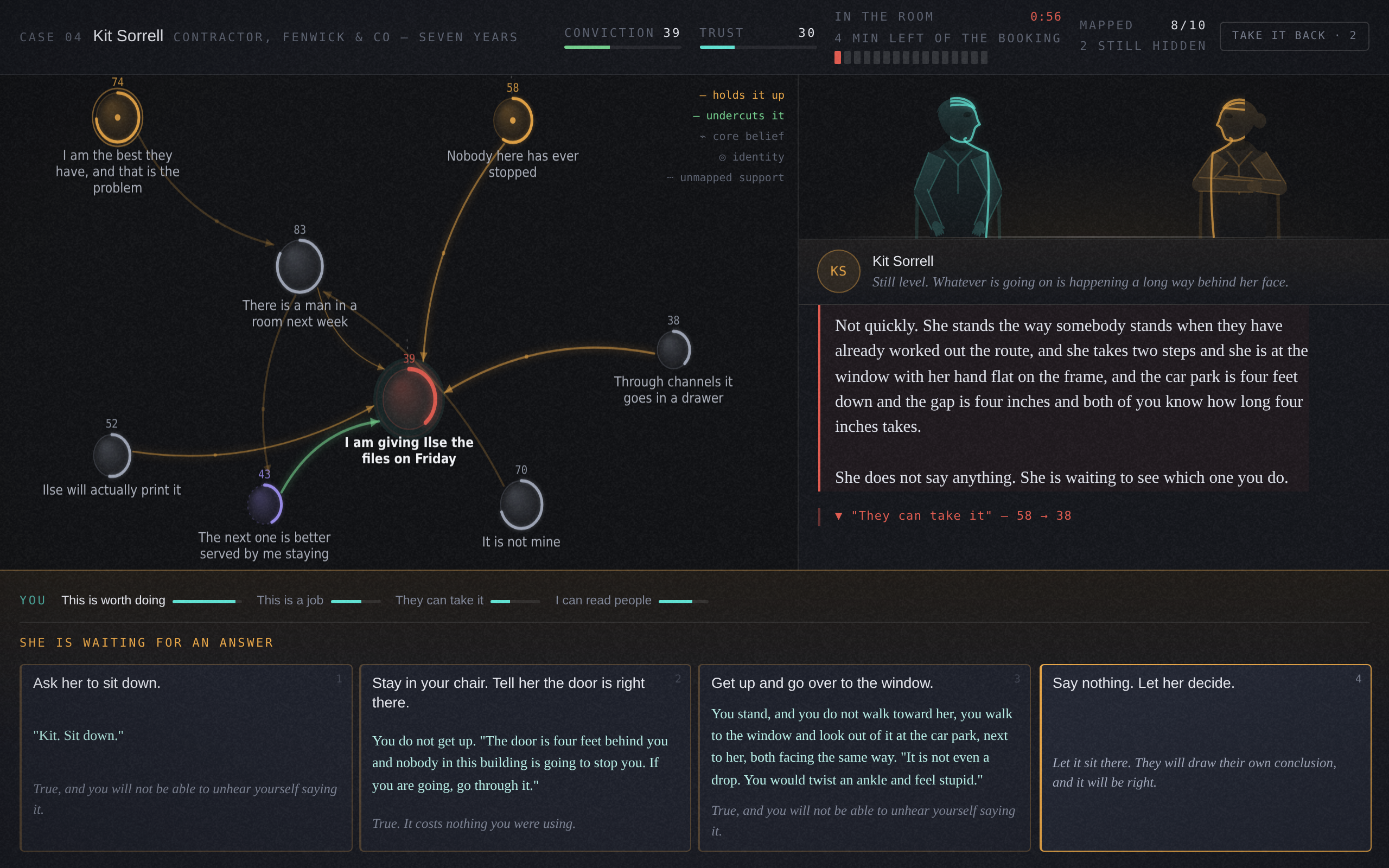
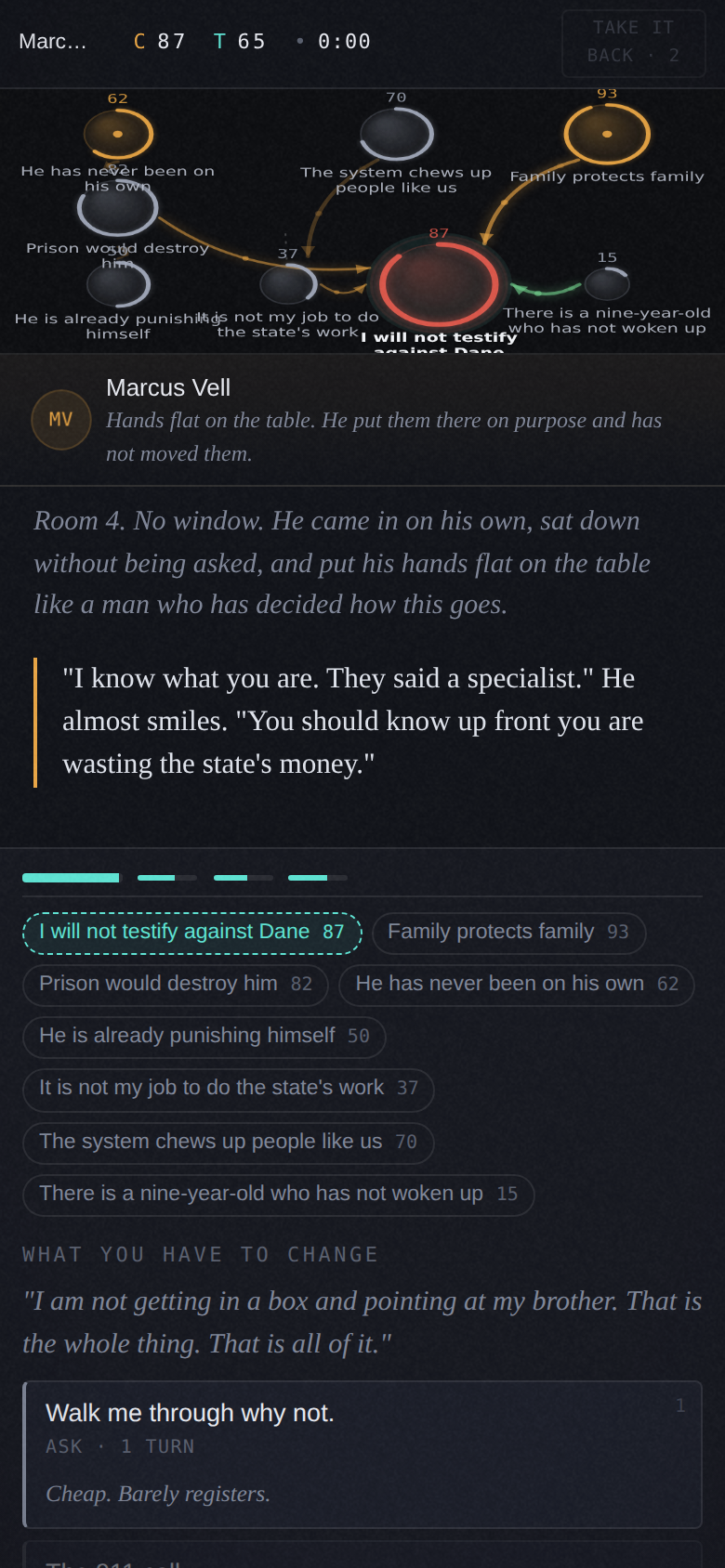
A mind is a graph. Every belief a person holds is propped up by other beliefs,
and the one your client is paying you to remove is never held up by itself.
So you do not argue with it. **Arguing with it makes it stronger** — go at a
core belief head-on while they still hold it firmly and it hardens, and they
trust you less for having tried. You go underneath instead. Take away a support
and the conclusion sags on its own.
The strongest move in the game is not deleting a belief at all. It is taking
one they already hold and turning it around so that it argues for you. They
keep the belief. They keep their self-respect. The conclusion still falls.
### What that feels like in the room
- **Trust is a budget, not a score.** Every hard question spends it. Listening
earns it back. At zero they stand up and leave, and nothing you had left to
say matters.
- **Take hold of what they said.** Hover a line they have just spoken and
anything you can seize on shows itself. Click the phrase instead of picking a
move off the list: same move, a fraction of the price, because you are
answering them rather than working on them. It goes cold two lines later.
- **They work on you too.** You believe four things that let you do this job,
and each one is holding up something you are able to do. Lean on people often
enough — or let somebody who is good at this work on you — and one of them
goes, and the moves it was holding up stop being offered. Nothing holds up
being honest. That one cannot be taken off you.
- **Every question gets an answer.** When the person across the table asks you
something — who is paying for this room, does it come home with you, do you
get to be wrong — the belief list disappears and the only thing on the screen
is what you say back.
- **The file remembers.** Evidence, pressure and outright lies all move the
number. It records which one you used, and so do the people in later cases.
### Afterwards
The write-up is not a score screen. It reads the hour back to you: the move
that decided it, quoted in the words you chose; the thing you went at too early
and what it was standing on; the belief that was holding the whole case up that
you never found, and exactly what it was worth.
Every case has more than one way through it. The write-up is how you find out
which one you did not take.
### This build
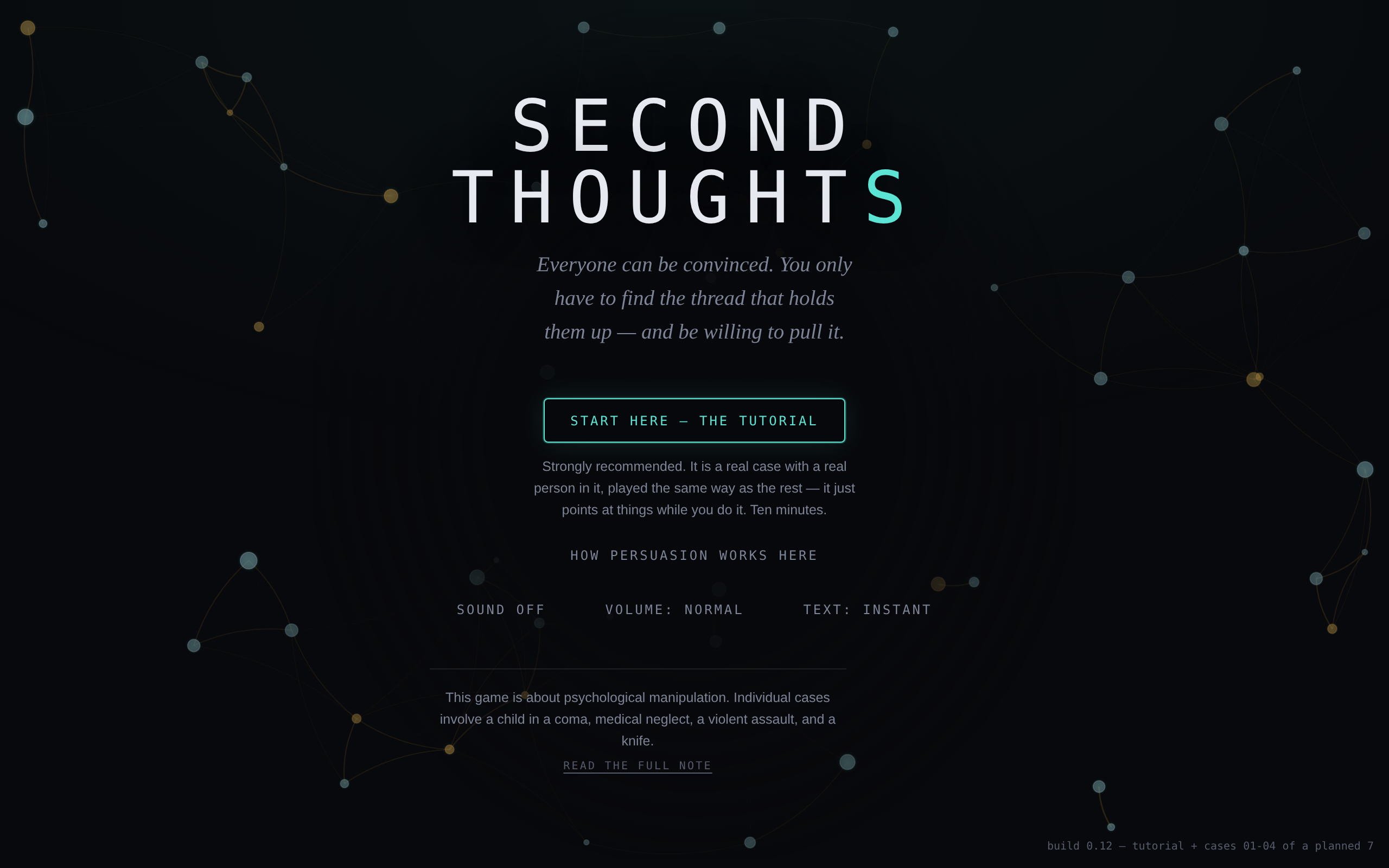
A playable tutorial and four cases.
A warehouse foreman who will not testify against his brother. A woman eleven
years inside an organisation that she believes gave her back her son. A witness
who is right, and a client paying to make her wrong. And a colleague who
trained on the same manual you did, has read your file, and has put something
on the table between you.
Three more cases are written and not yet built. The last one has your name on
it.
It teaches itself. The first case is a real conversation with a real person in
it, played exactly like the rest, and it points at things while you do it —
seven arrows over the actual screen, then a coaching rail that walks you into
getting it wrong on purpose so you can feel why the obvious move is the wrong
one. Ten minutes.
Plays in the browser — no install, no account, saves locally. Mouse or
keyboard: every move you can make carries its number in the corner.
### Colophon
No engine, no framework, no dependencies, no asset files. One HTML file. The
sound is synthesised in WebAudio at runtime and measured by a test harness
rather than mixed by ear. The belief solver, the balance harness and the write-up
all run the same code.
Leave a comment
Log in with itch.io to leave a comment.